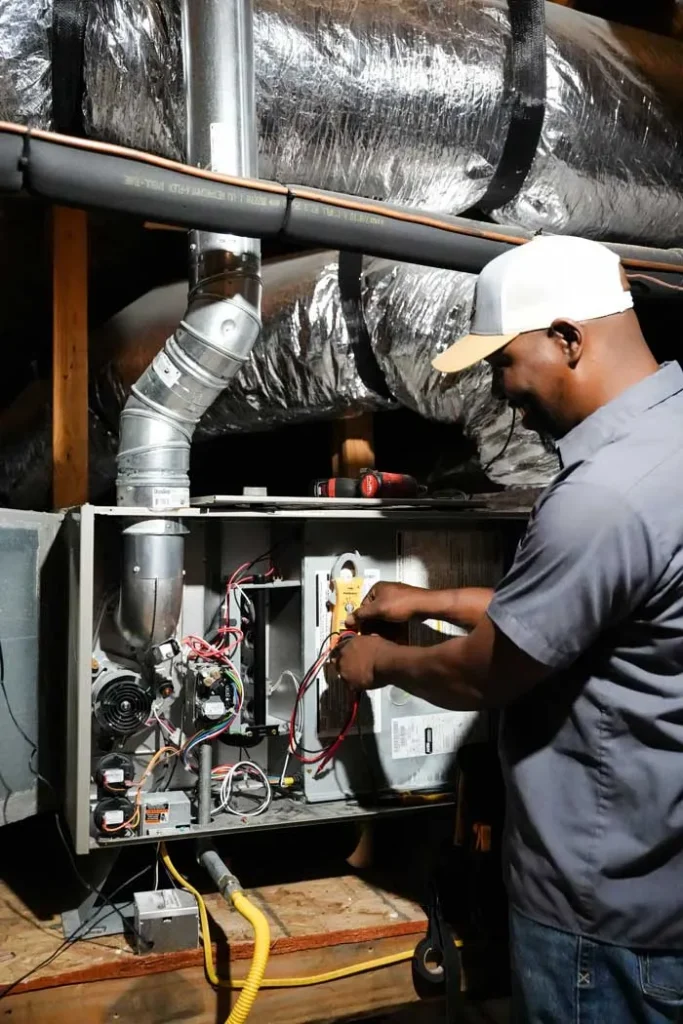
A furnace not working in El Campo, TX, almost always announces itself on the same night. The first real cold front comes through. Thousands of heaters switch on for the first time in nine months, and a share of them do not. That timing is not bad luck. It is also the reason this is the most preventable failure pattern in the trade.
Key Points
- A Gulf Coast furnace sits idle nine months a year, so problems that would surface early up north stay hidden until the first cold night.
- A furnace not working with repeated clicking and no flame points to a failed igniter. A burner that lights and quits after a few seconds points to a dirty flame sensor.
- Heat pumps fail differently than gas furnaces, and warm-but-not-hot air from a heat pump is normal, not a fault.
- A diagnostic visit from Cannell costs $85. Service Agreement members pay $75.
- A cracked heat exchanger is not a cost-comparison repair. That furnace comes out of service.
Why a Furnace Not Working Shows Up All at Once Here
A furnace here has an unusual job. It sits untouched from March to November. Then it runs hard for a few nights in December, goes quiet for three weeks, and runs hard again in January. Equipment does not like that pattern.
In a northern climate, a furnace runs most of the winter, so small problems announce themselves early. Here, those same problems sit dormant all summer.
Dust settles on the burner assembly and the flame sensor. Rodents and wasps find a flue or a cabinet that has been still for months. A cracked igniter that would have failed in November instead fails the night it drops to 24 degrees.
The summer did not cause the failure. The summer just hid it.
That timing also explains why storm weeks are the hardest weeks to get service. When a hard freeze reaches Wharton and Matagorda counties, every furnace not working in the county gets called in at once. The February 2021 freeze made that clear statewide. A furnace checked in October never joins that queue.
6 Signs Behind a Furnace Not Working
Six symptoms account for most cases of a furnace not working that we see between December and February.
1. It will not ignite
Modern systems use a hot surface igniter, and it is a wear part. You hear repeated clicking with no flame. Or the burner lights and shuts down immediately. Both point here.
2. It lights, then quits after a few seconds
Usually a dirty flame sensor. The furnace lights, cannot confirm the flame, and shuts the gas off as a safety measure. Cleaning the sensor is a straightforward fix.
3. It short cycles
The furnace runs for two minutes, stops, and starts again. Restricted airflow from a loaded filter is the first suspect. An overheating limit switch is the second.
4. It blows air that is not warm
Often the thermostat sits on ON instead of AUTO, which runs the blower between heating cycles. Sometimes the cause is an ignition failure.
5. The flame burns yellow or lazy
A properly burning natural gas flame is blue and steady. Yellow, flickering, or lifting flames mean incomplete combustion. That is a call to make now.
6. A burning smell keeps coming back
The first burn of the season smells like dust cooking off, and that clears within an hour. A smell that keeps returning does not. Neither does one that smells sharp rather than dusty.
Heat Pump Problems That Look Like a Furnace Not Working
Plenty of homes across this service area heat with a heat pump instead of a furnace. The failure list changes.
- Warm but not hot air is normal. A heat pump delivers air cooler than a gas furnace does. That is how the equipment works.
- An iced-over outdoor unit. Heat pumps run a defrost cycle in cold weather. Occasional frost is expected. A unit encased in ice is not.
- A high electric bill after a cold snap. The auxiliary electric heat strips are probably carrying the load because the heat pump cannot keep up.
- Cold air on a call for heat. A stuck reversing valve sends cooling when you asked for heating.
What Carbon Monoxide Has to Do With a Furnace Not Working
Any appliance that burns fuel produces carbon monoxide. A properly installed, properly vented furnace sends all of it outside. A cracked heat exchanger, a blocked flue, or a bird’s nest in a vent changes that. Carbon monoxide has no color and no smell, so a detector is the only thing that will find it.
Two steps cover you:
- Put a working CO alarm on every level of the home and outside sleeping areas, which matches CPSC’s carbon monoxide guidance. Test them when you change your clocks. Cannell installs carbon monoxide detectors as part of our indoor air quality work.
- Have the heat exchanger inspected every year. It is part of every furnace tune-up we perform, and you cannot check it yourself.
If a CO alarm sounds, get everyone outside first, then call from outside. That is the one place in this article where speed beats diagnosis.
5 Checks to Run Before You Call
Any one of these can turn a furnace not working into a two-minute fix.
- Thermostat. HEAT mode, set above room temperature, fan on AUTO, fresh batteries.
- Filter. A loaded filter causes more heating failures than any single component. If it is gray, replace it.
- The furnace switch. Most furnaces have a light-switch-style disconnect on or near the cabinet. It gets flipped by accident more often than you would think.
- The breaker. Gas furnaces still need electricity for the blower, the controls, and the igniter.
- Gas supply. If your range and water heater are also out, the gas service is the problem, not the furnace.
If all five check out and the house is still cold, the fault sits inside the equipment.
What It Costs to Fix a Furnace Not Working
Our diagnostic call is $85. Service Agreement members pay $75. That covers a technician finding the real fault instead of guessing at it.
Members also get 20% off repair labor and 10% off replacement parts. On a $400 part, that is $40 back before the labor discount lands.
Our labor carries a one-year warranty. If the same problem returns inside that year, we come back and re-diagnose it at no charge.
We stock our trucks so a furnace not working gets fixed on the first trip. About 99% of our service calls get repaired on the first visit. We price the repair after we diagnose it, and that price stays competitive and fair with no hidden or surprise costs.
Repair or Replace? Run the Numbers
The same arithmetic applies to heating as to cooling.
Age. Gas furnaces commonly run 15 to 20 years. Heat pumps work year-round in this climate, so they land closer to 10 to 15.
The cost-versus-age test. Multiply the system’s age by the repair estimate. If it clears about $5,000, replacement usually wins. An 18-year-old furnace with a $700 repair comes to $12,600, which is a replacement conversation. A 7-year-old furnace with the same repair comes to $4,900, so you fix it.
A cracked heat exchanger is different. That one is not a cost comparison. A cracked exchanger takes the furnace out of service, and replacement is the practical answer on most systems.
Call frequency. A furnace not working twice in one winter is a pattern, not bad luck.
Two systems, one decision. If your furnace and air conditioner share an age and a cabinet, replacing both together usually costs less than replacing them two years apart. The equipment also comes matched. Our current specials include $100 off a system change-out when new heating and cooling equipment go in together. Coupon terms and dates change, so confirm what is running when you call.
Whichever way it goes, the estimate is free, and the owner or a technician performs it rather than an aggressive salesperson. You get told what your system needs, including the times the answer is that your furnace is fine.
The Tune-Up That Prevents a Furnace Not Working
A tune-up before the season is the least expensive heating work you will ever pay for. Ours covers cleaning the burner assembly and flame sensor, inspecting the heat exchanger, and verifying ignition and safety controls. We also check the blower and confirm the system shuts down when it should.
Our Service Agreement covers two performance tune-ups a year, heating before winter and cooling before summer. It adds priority service, the $75 diagnostic rate, 20% off repair labor, 10% off parts, and 5% off a new system. Ask us for current pricing.
October and November are the right months to book it. December is when everybody else does.
Why El Campo Homeowners Call Cannell
We have serviced heating systems in this area since 1966. The company is family-owned, and our people bring over 210 years of combined experience to the work. Our technicians are NATE certified.
We hold a Texas license TACLA003986C and carry full insurance. We are BBB accredited with an A+ rating and a member of the Comfort Institute. Carrier has authorized us as a Factory Authorized Dealer since the company’s inception and has given us the President’s Award for Excellence in 2019 and 2020.
Any job, no matter how large or small.
Book Your Heating Tune-Up Before the Front Comes Through
Check your thermostat, your filter, the furnace switch, and the breaker. If your furnace is not working after all five checks, the problem sits in the equipment.
Call Cannell Air Conditioning & Heating at 979-543-6485, or toll-free at 800-696-3760 at no extra cost. Book a heating tune-up now and you stay ahead of the first cold front. Ask for the free estimate and the owner or a technician will tell you whether your furnace is worth repairing.
Find us at 1006 E Jackson St in El Campo, TX. We serve El Campo, Wharton, Bay City, Victoria, Edna, Palacios, Port Lavaca, Eagle Lake, Columbus, and Rosenberg, plus Wharton, Matagorda, Colorado, and Jackson counties. Monday through Friday, 8 to 5, with emergency service available by appointment.